
Handcrafted Linocut Prints
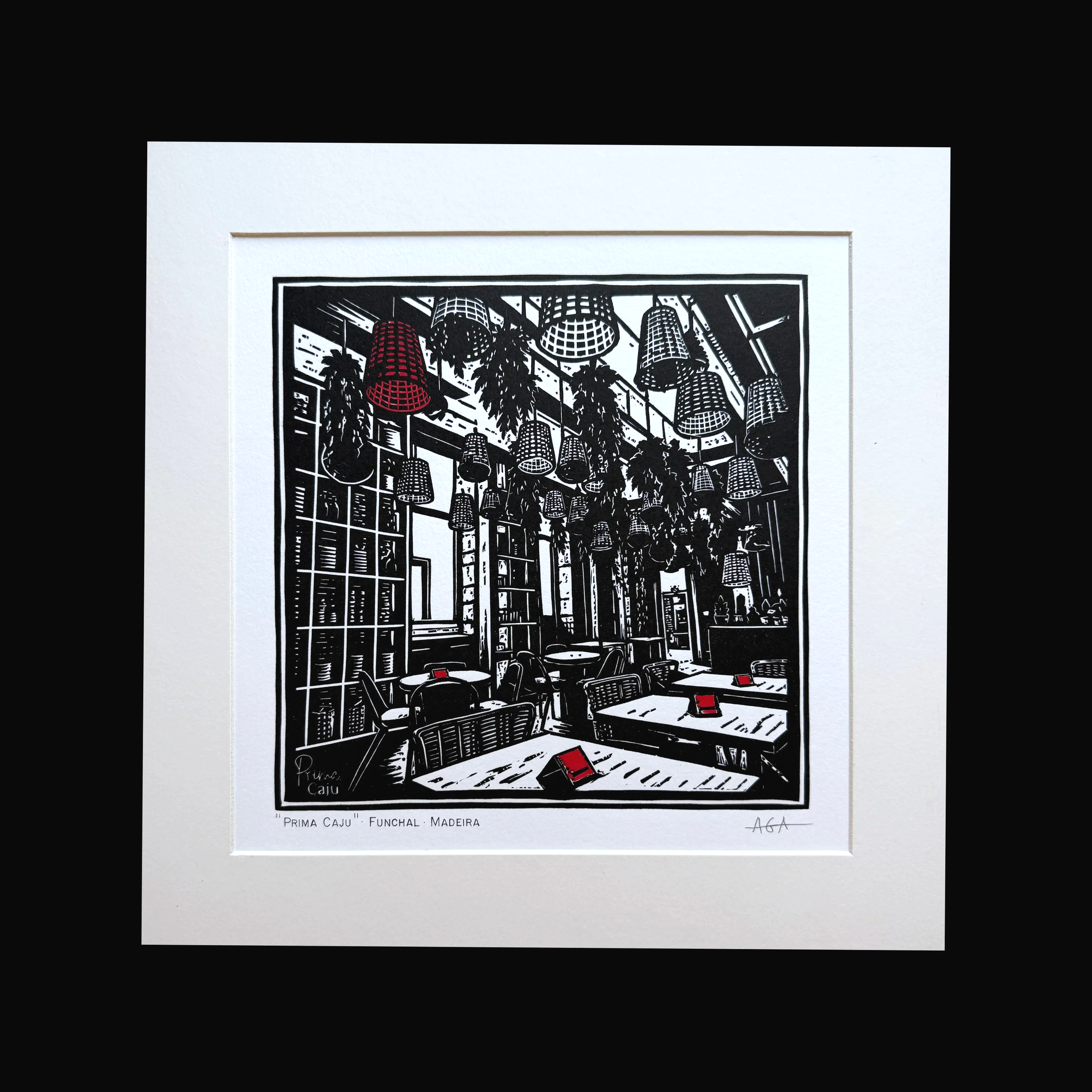
Madeira
Madeira Handcrafted Prints is a series of original square-format relief prints inspired by the island’s dramatic coastline, botanical gardens, volcanic landscapes, historic architecture, and iconic locations. Each work is created in a distinctive visual language built around dense lamp-black masses contrasted by restrained deep red accents.
The prints combine traditional linocut techniques with hand-applied details using oil-based inks such as Van Son Rubber Base Plus and red pigment markers. Every piece is carved by hand with ultra-fine precision using Swiss Pfeil tools and watchmaker’s magnification. Printed on archival 100% cotton paper (250gsm+) using a roller press or, in selected editions, entirely by hand. Each print is individually signed in technical calligraphy using archival ink.
View Project →
Photography

617 Toscana
One does not rush when shooting with a film camera. The eye follows the curve of the horizon, lingers on unexpected details, and slowly composes the image long before the shutter is released. All that remains is to discover the landscapes worthy of being captured.
These photographs of Tuscany were taken in November — a season when the light becomes softer, quieter, and deeply cinematic. Every corner of Tuscany possesses its own beauty, yet the true paradise for a photographer is Val d’Orcia: rolling plains, gentle hills, dark cypress trees, scattered villas, and ancient hill towns suspended in time. For years , these landscapes have inspired painters, filmmakers, and travelers alike. They appear in Renaissance art and in some of cinema’s most memorable scenes — from Federico Fellini’s 8½ (1963) to Anthony Minghella’s The English Patient (1996), Bernardo Bertolucci’s Stealing Beauty (1996), and Ridley Scott’s Gladiator (2000).
At the same time, this journey was not limited to Val d’Orcia alone. I also photographed the tufa towns of Sorano and Pitigliano in the province of Grosseto, as well as the iconic medieval skyline of San Gimignano.
View Project →
Life En Pointe

Life is movement. A camera has the unique ability to seize fleeting moments from the endless flow of time, preserving fragments of motion that would otherwise disappear forever. In a fraction of a second, photography reveals the fragile beauty of transience. “Beautiful moment, do not pass away!” wrote Goethe — and within the photograph, time itself seems to stand still.
Ballet embodies this same elusive poetry of movement: weightless gestures, suspended flight, impossible balance. Dancers appear to master velocity precisely at the instant they freeze in motion. Edgar Degas captured this delicate tension with extraordinary sensitivity, transforming ephemeral gestures into timeless images. More than a century after his passing, his vision continues to inspire artists across disciplines.
Life En Pointe was created as a tribute to this world of movement, grace, and suspended time. The project brings together photographer Hermann Einbinder, calligraphic artists Vika and Vita Lapukhiny, and writer Robert Saikia in a collaborative exploration of dance and visual poetry. The result is a handcrafted art book published by The Book Brothers Atelier.
View Project →

On The Night Streets
Light painting has long been part of photographic practice, though it is most commonly associated with controlled studio environments. My approach explores this technique in a different context — within open urban spaces, at night and in the fading light of dusk — with the intention of creating experimental, painterly atmospheres within real city landscapes.
The process begins with stillness. The camera is placed on a tripod, the shutter remains open, and time itself becomes part of the composition. Then the transformation begins. Using a powerful, focused beam of light, I shape the scene directly within the frame — revealing textures, emphasizing forms, and introducing subtle visual accents that do not exist in ordinary perception.
Light becomes more than illumination; it becomes a drawing instrument. Each movement leaves a trace, allowing the final image to emerge somewhere between photography, painting, and performance.